THE COMMUNICATION REVOLUTION
THE ELECTRIC AGE CHRONICLE
HISTORY · INVENTION · GLOBAL CONNECTION
When Messages Began Traveling Faster Than People
How electrical signals transformed communication, connected distant cities, and helped create the foundations of the modern information age.
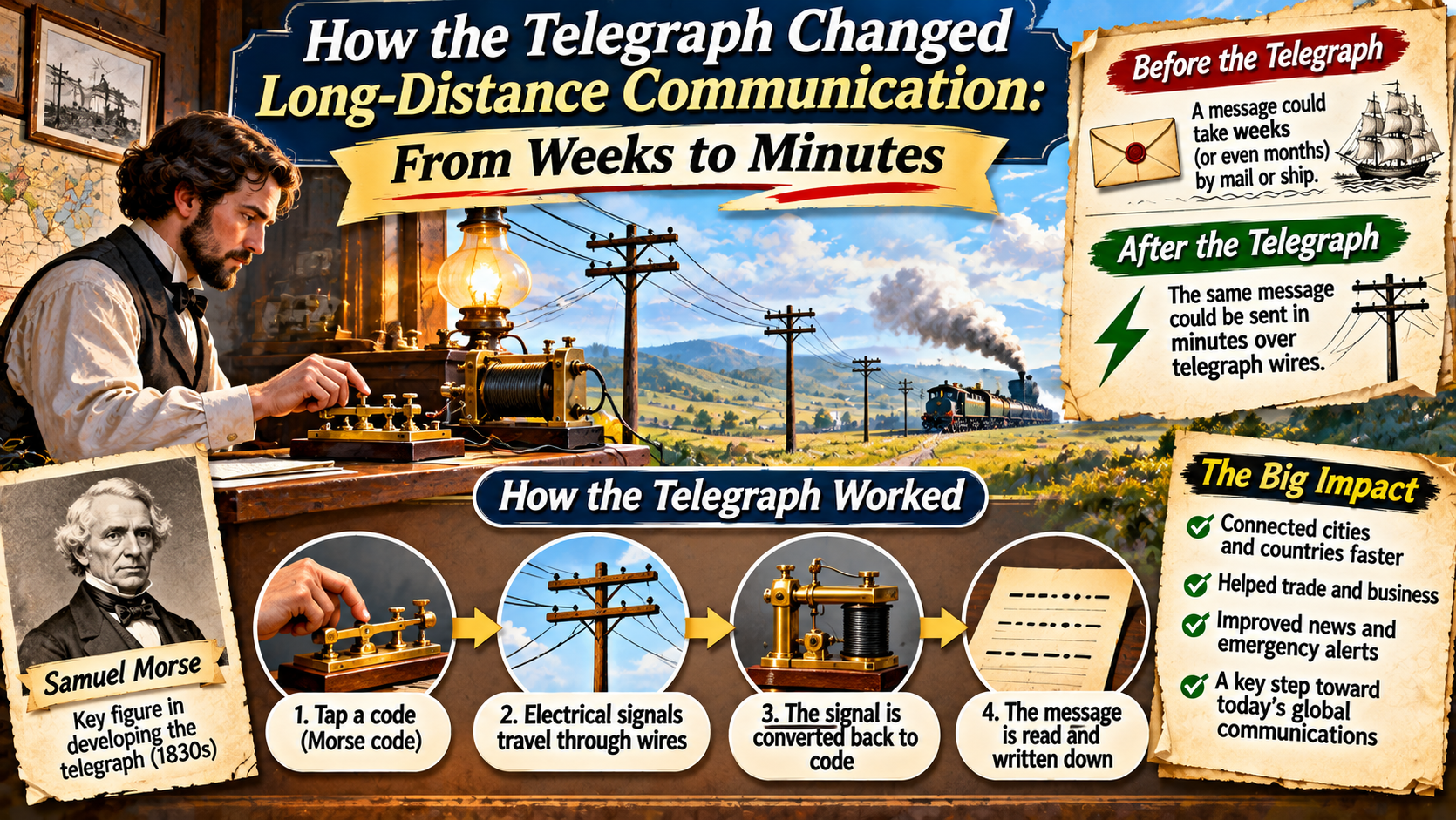
For much of human history, sending information across long distances depended on physically transporting a message. Letters traveled by horseback, sailing ships, stagecoaches, and eventually railways. Even urgent news could take days, weeks, or months to reach its destination.
The invention and expansion of the electric telegraph fundamentally changed this relationship between distance and communication.
Instead of waiting for a messenger to complete a journey, people could transmit information through electrical signals traveling along wires.
By the middle of the nineteenth century, telegraph networks were connecting major cities. Later, submarine cables extended communication across oceans.
The telegraph did not simply make messages faster. It changed how businesses operated, how governments communicated, how newspapers gathered information, and how societies understood distant events.
Its development marked a major turning point in the history of communication technology.
Communication Before the Telegraph
Before electrical communication became practical, the speed of information was closely connected to the speed of transportation.
A message traveling between distant cities might be carried by a horse, coach, train, or ship.
Improved roads and transportation networks gradually reduced delivery times, but geographic distance remained a major obstacle.
Ocean crossings presented an especially difficult challenge.
News sent from Europe to North America depended on ships completing voyages across the Atlantic.
Weather conditions, transportation schedules, and political disruptions could delay delivery.
Governments and commercial organizations therefore often made decisions using information that was already outdated.
Although optical semaphore systems and other signaling methods offered faster communication over certain routes, they had limitations involving visibility, weather, infrastructure, and distance.
Electrical telegraphy introduced a different possibility: transmitting messages without physically moving the written document.
The Development of the Electric Telegraph
The telegraph emerged through contributions from multiple inventors and researchers rather than a single isolated discovery.
Early nineteenth-century experiments demonstrated that electricity and electromagnetism could be used to communicate information.
In Britain, William Fothergill Cooke and Charles Wheatstone developed an electrical telegraph system that became important in railway communication.
In the United States, Samuel Morse worked with collaborators, including Alfred Vail, on a system using electrical pulses and coded messages.
These developments occurred during a period when electrical science was advancing rapidly.
The practical challenge was not merely sending a current through a wire.
Inventors also needed reliable equipment, signaling methods, electrical power, and networks capable of operating over useful distances.
As these systems improved, telegraphy became increasingly practical for commercial and public communication.
ARCHIVAL TIMELINE · THE RISE OF TELEGRAPHY
Practical electrical telegraph systems are developed in Britain and the United States.
Samuel Morse sends a famous demonstration message between Washington, D.C., and Baltimore.
Telegraph networks expand across major commercial and transportation routes.
The first transcontinental telegraph line is completed in the United States.
A durable transatlantic telegraph cable begins successful service, enabling sustained communication across the ocean.
How the Telegraph Actually Worked
Early electric telegraph systems transmitted information through controlled changes in electrical current.
A typical system included a sending instrument, an electrical circuit, a transmission wire, and receiving equipment.
An operator pressed a telegraph key to complete an electrical circuit.
This action sent an electrical signal along the wire.
At the receiving end, an electromagnetic device responded to the signal.
Depending on the equipment, it could create audible clicks, move an indicator, or mark a recording surface.
The receiving operator interpreted the signals and reconstructed the message.
Different telegraph systems used different signaling methods.
Some relied on coded pulses, while others used visual indicators or printing mechanisms.
As networks expanded, operators became highly skilled at transmitting and interpreting messages efficiently.
Morse Code: Turning Language into Electrical Signals
Morse code became one of the most recognizable elements of telegraph communication.
It represents letters, numbers, and other characters through combinations of short and long signals.
These signals are commonly called dots and dashes.
In an electrical telegraph system, an operator could create different signal durations by controlling a telegraph key.
The receiving operator interpreted the pattern to identify the intended characters.
American Morse code was used in early American telegraphy, while International Morse code later became important for broader communication.
The two systems are related but not identical.
SIGNAL ROOM / INTERNATIONAL MORSE CODE
S · · ·
O — — —
S · · ·
SOS is a well-known international distress signal adopted after the earliest telegraph era.
Morse code was effective because it allowed language to be represented using a relatively simple signaling system.
However, transmitting a message still required time and trained operators.
Long messages took longer to send than short ones, and communication capacity depended on the equipment and network.
From Weeks to Minutes: Why the Speed Difference Mattered
The most dramatic advantage of telegraphy was the separation of communication speed from transportation speed.
Before the telegraph, a message sent across a country might require a physical journey lasting days or longer.
With a functioning telegraph connection, a short message could travel between connected locations in minutes, including the time needed for handling and transmission.
Electrical signals moved rapidly through wires, although actual message delivery also depended on operators, relay stations, traffic, and network conditions.
The improvement was especially important for time-sensitive information.
Businesses could receive market updates sooner.
Railway companies could coordinate operations across greater distances.
Government officials could exchange urgent instructions without waiting for couriers.
The telegraph made distant events feel more immediate.
How Telegraph Networks Changed the News Industry
Newspapers were among the institutions most affected by telegraphy.
Before electrical communication, reporting on distant events often depended on letters and transportation networks.
By the time news reached readers, circumstances could have changed substantially.
Telegraph networks allowed correspondents to send reports much more quickly.
Editors could receive updates about political events, financial markets, disasters, and military developments.
Organizations such as the Associated Press developed within a changing news environment in which cooperation and rapid information distribution became increasingly important.
Because telegraph messages could be expensive, journalists had incentives to communicate important facts efficiently.
Telegraphy influenced the organization of news gathering and contributed to the development of faster reporting practices.
It also expanded expectations about how quickly the public should receive information.
The Telegraph and the Expansion of Railways
Railway transportation and electrical telegraphy developed alongside one another during the nineteenth century.
Railway companies needed reliable ways to coordinate trains traveling over shared tracks and complex networks.
Telegraph lines provided an important means of communicating instructions between stations.
Dispatchers could exchange information about train movements, schedules, and operational conditions.
This improved coordination and supported the development of more systematic railway operations.
Telegraph networks were not a complete solution to railway safety, and accidents still occurred.
Nevertheless, rapid communication became an essential component of increasingly sophisticated rail systems.
Railway routes also provided practical corridors for installing telegraph lines.
The relationship between the two technologies helped expand communication infrastructure.
How Businesses Used the Telegraph
Commercial organizations quickly recognized the value of faster information.
Merchants could communicate prices, orders, and shipping arrangements across distant markets.
Financial institutions could receive updates from trading centers without waiting for written correspondence.
Businesses operating in multiple cities gained new opportunities to coordinate decisions.
Telegraphy also encouraged the development of specialized financial information services.
However, access was not equally affordable or available to everyone.
Sending telegrams involved fees, and network coverage was concentrated in connected regions.
Despite these limitations, the telegraph contributed to the growing integration of regional and international markets.
The Transatlantic Cable: Connecting Continents
One of the most ambitious telegraph projects involved laying electrical cables beneath the Atlantic Ocean.
Connecting Europe and North America required overcoming enormous engineering challenges.
Cables had to withstand the conditions of the ocean environment while transmitting electrical signals across extraordinary distances.
An early transatlantic cable briefly operated in 1858, generating widespread excitement.
However, it failed after a short period of service.
Further efforts eventually produced a durable transatlantic connection in 1866.
This achievement dramatically reduced the communication delay between the continents.
Information that previously depended on an ocean voyage could now be transmitted electrically.
International trade, diplomacy, journalism, and financial communication all benefited from the new connection.
Submarine telegraph cables became important components of an expanding global communication network.
Communication Before and After the Telegraph
| Feature | Before Electric Telegraphy | With Telegraph Networks |
|---|---|---|
| Message delivery | Physical transportation | Electrical signals through wires |
| Long-distance speed | Often days or weeks | Potentially minutes between connected offices |
| International news | Dependent on ships and couriers | Rapid transmission through connected cable networks |
| Business coordination | Delayed correspondence | Faster exchange of commercial information |
| Railway operations | Limited long-distance coordination | Improved communication between stations |
| Key limitations | Travel time and transportation conditions | Infrastructure, cost, operators, and network capacity |
How the Telegraph Influenced Government and Diplomacy
Governments also recognized the strategic value of rapid communication.
Officials could transmit instructions across national territories and communicate with representatives in distant regions.
Military organizations used telegraph systems to exchange information and coordinate activities.
During the American Civil War, telegraph communication played an important role in transmitting military information and orders.
International diplomacy changed as submarine cables made communication between governments faster.
However, faster communication also introduced new concerns involving secrecy, interception, and the control of information.
Encryption and secure communication practices became increasingly important.
The telegraph therefore influenced both the opportunities and challenges of modern state communication.
The Limitations of Telegraph Technology
Despite its revolutionary impact, the telegraph was not a perfect communication system.
Users generally needed access to a telegraph office or another connected facility.
Messages had to be transmitted, received, and delivered through an organized service.
Long-distance connections could involve multiple operators or relay points.
Weather, equipment failures, damaged wires, and cable problems could interrupt communication.
Telegram fees also made frequent or lengthy communication expensive for some users.
Telegraph systems were therefore most useful where infrastructure existed and the value of rapid communication justified the cost.
These limitations later encouraged the development and adoption of other communication technologies.
From Telegraph Wires to Modern Digital Communication
The telegraph helped establish the idea that information could be encoded, transmitted electrically, and reconstructed at a distant location.
This principle influenced later developments in telecommunications.
The telephone introduced electrical transmission of speech, while radio communication eventually made wireless signaling practical.
Twentieth-century telecommunications networks expanded the speed and capacity of global information exchange.
Modern digital communication uses technologies far more sophisticated than nineteenth-century telegraph systems.
Nevertheless, the basic concept of representing information through signals remains central to communication engineering.
Today, fiber-optic cables, satellites, mobile networks, and internet infrastructure connect people across the world.
The telegraph was an important early step toward that interconnected environment.
Frequently Asked Questions
Who invented the electric telegraph?
Several inventors contributed to its development. Important figures include Samuel Morse, Alfred Vail, William Fothergill Cooke, and Charles Wheatstone.
When did the telegraph become widely used?
Electrical telegraph networks expanded significantly during the middle of the nineteenth century, although adoption varied by country and region.
How fast could a telegraph message travel?
Electrical signals traveled rapidly through wires, allowing short messages to reach connected offices in minutes under favorable operating conditions.
Did every telegraph use Morse code?
No. Different telegraph systems used different methods, including coded pulses, needle indicators, and printing mechanisms.
Why was the transatlantic telegraph cable important?
It enabled rapid electrical communication between Europe and North America, replacing the need to wait for ships to carry every message.
How did the telegraph change newspapers?
It allowed news organizations to receive reports from distant locations much faster, helping transform the speed and organization of journalism.
Is the telegraph still important today?
Traditional commercial telegraph services have largely been replaced, but telegraphy remains historically important to the development of modern telecommunications.
Final Thoughts
The electric telegraph transformed long-distance communication by allowing information to travel independently of physical transportation.
Messages that once required lengthy journeys could be transmitted through electrical networks in a fraction of the time.
This breakthrough influenced commerce, journalism, railways, government administration, and international relationships.
The expansion of submarine cables extended these changes across oceans and helped establish a new era of global communication.
Although later technologies eventually replaced most traditional telegraph services, the telegraph’s historical importance remains enormous.
It introduced a practical model for sending encoded information over long distances and helped establish expectations of rapid communication.
In doing so, it became one of the defining technologies of the modern information age.