THE EVERYDAY HISTORY EDITION · HOME & KITCHEN
The Icebox Era: When Keeping Food Cold Required a Delivery
Before electric refrigerators became common, households depended on insulated cabinets, harvested ice, and regular deliveries to keep perishable food cool.
Today, keeping food cold is so ordinary that most people rarely think about it. Milk goes into the refrigerator, leftovers are stored on a shelf, and fresh ingredients remain chilled until they are needed.
For households living before modern electric refrigeration, maintaining cool food storage was a much more demanding task.
Families relied on methods such as cellars, drying, salting, smoking, and seasonal storage. Fresh meat, dairy products, and other perishable foods could be especially difficult to preserve during warm weather.
Then came the household icebox.
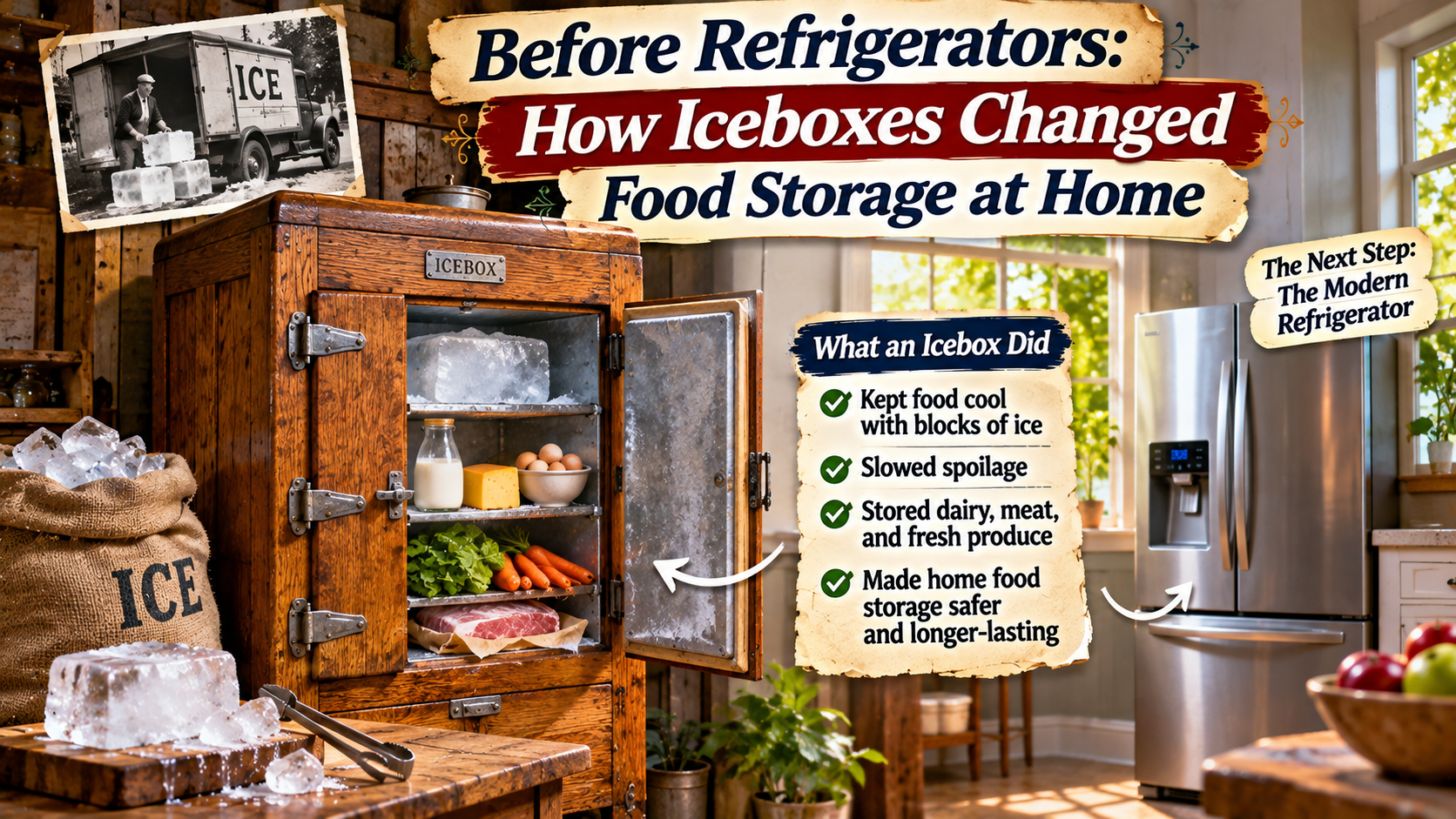
An icebox was an insulated storage cabinet that used blocks of natural or manufactured ice to keep food cooler than the surrounding room. It did not produce cold air through an electrical refrigeration system. Instead, it depended on a supply of ice that gradually melted as it absorbed heat.
Although simple compared with modern appliances, iceboxes transformed everyday household routines and helped expand access to chilled foods.
Their history also reveals an overlooked network of ice harvesters, delivery workers, manufacturers, and families who helped make refrigerated food storage possible.
How People Stored Food Before Iceboxes
Before household iceboxes became widely available, food preservation depended heavily on local climate and traditional techniques.
In colder regions, people sometimes stored food in cellars, underground rooms, or specially constructed storage spaces.
These areas could remain cooler than ordinary living spaces because surrounding soil moderated temperature changes.
However, cellars did not provide the consistent low temperatures associated with modern refrigeration.
Other preservation methods focused on reducing spoilage without relying on cooling.
Drying removed moisture from food, while salting and smoking helped preserve certain meats and fish.
Pickling and fermentation also allowed families to store selected foods for longer periods.
These techniques remained valuable even after iceboxes became available.
Nevertheless, many households wanted a practical way to keep fresh food cool without completely changing its form or flavor.
What Exactly Was an Icebox?
A household icebox was a cabinet designed to slow the movement of heat from the surrounding room into a food-storage compartment.
Many models resembled pieces of furniture, with wooden exteriors, insulated walls, and separate compartments for ice and food.
The interior might be lined with metal or another material that could be cleaned more easily than unfinished wood.
Insulation materials varied by manufacturer and period. Some designs used cork, sawdust, or other materials to reduce heat transfer.
A block of ice was placed in a dedicated compartment, commonly near the upper portion of the cabinet.
As the ice absorbed heat, it gradually melted.
The cooler environment helped slow food spoilage, although temperatures were not always consistent throughout the cabinet.
Iceboxes varied considerably in size, construction quality, and affordability.
Some were relatively simple household cabinets, while more expensive models included decorative finishes and improved insulation.
INSIDE THE ICEBOX / COMPONENT GUIDE
Held a block of ice that absorbed heat from the cabinet’s interior.
Reduced the rate at which warmth entered from the surrounding room.
Provided space for milk, butter, meat, and other foods that benefited from cooling.
Directed melting ice water into a removable pan or another collection arrangement.
How an Icebox Kept Food Cold Without Electricity
The science behind an icebox was straightforward but effective.
Heat naturally flows from warmer surroundings toward cooler areas.
When a block of ice sits inside an insulated cabinet, it absorbs heat from the air, food, and surrounding surfaces.
Melting ice requires energy. This energy is taken from the environment around the ice, helping maintain a cooler space inside the cabinet.
Insulation slows the rate at which additional heat enters.
However, an icebox cannot maintain low temperatures indefinitely.
As the ice melts, the cabinet gradually loses its cooling capacity.
Eventually, the household must replace the ice to continue using the appliance effectively.
The amount of ice needed depends on factors such as room temperature, cabinet insulation, how often the doors are opened, and the amount of food stored.
THE SCIENCE OF EVERYDAY COOLING
An Icebox Did Not Create Cold. It Used Melting Ice to Absorb Heat.
This principle explains why the cabinet required both insulation and a regular supply of replacement ice.
The Rise of the Commercial Ice Industry
Household iceboxes depended on a larger industry capable of supplying ice to homes and businesses.
During the nineteenth century, commercial ice harvesting expanded significantly in parts of North America and Europe.
Workers cut large blocks of ice from frozen lakes, ponds, and rivers during winter.
The blocks were transported to icehouses, where insulating materials helped slow melting.
Stored ice could then be distributed during warmer months.
American entrepreneur Frederic Tudor became an important figure in the early commercial ice trade, helping develop markets for natural ice during the nineteenth century.
As transportation networks improved, ice could be shipped farther from harvesting locations.
Later, mechanical ice-making technology allowed ice to be produced in facilities without depending entirely on naturally frozen water.
This development helped support ice supplies in regions where natural harvesting was difficult or unreliable.
The Ice Delivery Worker: A Familiar Neighborhood Figure
For many households, keeping an icebox operating required regular visits from an ice delivery worker.
Ice was transported through neighborhoods using wagons and, later, motor vehicles.
Delivery workers carried heavy blocks into homes and placed them inside ice compartments.
Specialized tongs and other equipment helped workers handle the slippery blocks.
Some households displayed cards or signs indicating the amount of ice they wanted delivered.
The frequency of deliveries depended on the weather, the household’s needs, and the size of its icebox.
During hot weather, ice melted faster, increasing the need for replacement.
The ice delivery system became an important part of everyday urban life before electric refrigeration became widespread.
A DAY IN THE ICEBOX ERA
A household member checks whether enough ice remains to keep food cool.
An ice delivery worker brings fresh ice when needed.
The household avoids unnecessary door opening to slow melting.
Water collected from melting ice is removed when necessary.
How Iceboxes Changed the Foods Families Could Keep
Before reliable household cooling, many perishable foods required careful planning.
Fresh milk could spoil relatively quickly in warm conditions.
Meat, butter, and other products also required appropriate handling and storage.
Iceboxes helped households keep selected foods cooler for longer periods than ordinary room-temperature storage allowed.
This increased flexibility in meal preparation and grocery shopping.
Families could store certain ingredients between shopping trips instead of purchasing everything immediately before use.
However, iceboxes did not eliminate food safety risks.
Temperatures could fluctuate, and inadequate ice supplies could allow food to warm.
Modern food safety standards should not be assumed to have been consistently achievable with historical icebox equipment.
Still, the icebox represented a major improvement in household food management.
How Iceboxes Changed Grocery Shopping and Home Life
The growing availability of iceboxes influenced how households organized food purchases.
Access to cooling made it easier to keep certain fresh ingredients at home between meals.
It also supported changes in food distribution.
Businesses involved in dairy, meat, and other perishable products benefited from improvements in cold storage and transportation.
However, household iceboxes were only one part of this broader transformation.
Refrigerated railcars, commercial icehouses, and other cooling technologies also contributed to expanding food markets.
These developments helped connect food producers with consumers across greater distances.
For households, the result was a gradual change in expectations about the availability and storage of fresh food.
The Problems and Limitations of Iceboxes
Despite their usefulness, iceboxes had several disadvantages.
They required a continuing supply of ice, which created an ongoing expense.
Households also depended on delivery services or another reliable source of replacement blocks.
Melting ice produced water that needed to be collected and removed.
If a drip pan overflowed or drainage failed, water could damage surrounding surfaces.
Temperature control was another major limitation.
Unlike modern refrigerators, traditional iceboxes generally lacked automatic thermostatic cooling systems.
Internal temperatures changed as ice melted and warm air entered the cabinet.
Iceboxes also required regular cleaning to maintain acceptable household conditions.
These limitations made mechanical refrigeration increasingly attractive as the technology improved.
Iceboxes vs. Modern Refrigerators
| Feature | Traditional Icebox | Modern Refrigerator |
|---|---|---|
| Cooling source | Stored ice | Mechanical refrigeration system |
| Electricity | Not required for basic operation | Generally required |
| Temperature control | Limited and variable | Automatic temperature regulation |
| Maintenance | Replace ice and remove meltwater | Cleaning and occasional servicing |
| Cooling duration | Depends on available ice | Continuous while functioning and powered |
| Food storage | Improved cooling with variable conditions | More consistent cooling when properly operated |
When Did Electric Refrigerators Replace Iceboxes?
Mechanical refrigeration developed over the nineteenth century, initially finding important applications in industrial and commercial settings.
Household electric refrigerators began appearing in the early twentieth century.
However, early models could be expensive and were not immediately practical for every household.
As manufacturing improved and electrical infrastructure expanded, refrigerators became more accessible.
During the 1920s and 1930s, household refrigeration technology developed rapidly in the United States.
Adoption continued to increase during the following decades.
By the middle of the twentieth century, electric refrigerators had become common in many American homes, although the transition varied by location and household income.
Iceboxes gradually disappeared from everyday use as automatic refrigeration offered greater convenience and more reliable temperature control.
The word “icebox” nevertheless survived in everyday speech, sometimes continuing to refer to refrigerators long after the original appliances became uncommon.
Why Iceboxes Matter in the History of Technology
Iceboxes may appear simple compared with modern household appliances, but their influence extended beyond the kitchen.
They demonstrated how insulation and stored cooling materials could improve everyday food preservation.
They also created demand for large-scale ice harvesting, storage, manufacturing, and distribution.
The ice industry connected natural resources, transportation systems, and household consumption.
Iceboxes helped families become accustomed to keeping perishable food in dedicated cooling cabinets.
That expectation contributed to the market for mechanical refrigerators when they became more practical.
In this way, the icebox served as an important technological bridge between traditional preservation methods and modern refrigeration.
Frequently Asked Questions
What did people use before refrigerators?
People used iceboxes, cellars, icehouses, and preservation methods such as salting, drying, smoking, pickling, and fermentation.
How did an icebox work without electricity?
An icebox used stored ice to absorb heat from an insulated cabinet, helping keep food cooler than the surrounding room.
Where did households get ice for their iceboxes?
Ice came from natural harvesting operations or mechanical ice-making facilities and was often delivered directly to homes.
How long did ice last inside an icebox?
It depended on the size of the ice block, insulation quality, surrounding temperature, and how frequently the cabinet was opened.
Were iceboxes as safe as modern refrigerators?
No. Iceboxes could provide useful cooling, but their temperatures were less consistent and depended on maintaining an adequate ice supply.
When did refrigerators become common in homes?
Electric refrigerators became increasingly common in many American households during the first half of the twentieth century, particularly as costs fell and electrical access expanded.
Why do some people still call refrigerators iceboxes?
The term survived as a familiar expression after electric refrigerators replaced traditional ice-cooled cabinets.
Final Thoughts
Before modern refrigerators became everyday household appliances, keeping food cold required planning, maintenance, and a dependable supply of ice.
Iceboxes provided a practical way to store perishable foods at cooler temperatures and helped change household routines.
Their popularity supported the growth of a major ice industry involving harvesting, manufacturing, transportation, and home delivery.
Although iceboxes had limitations, including melting ice and inconsistent temperature control, they represented an important improvement over many earlier food-storage methods.
Electric refrigerators eventually offered greater convenience and more reliable cooling, but they built upon a household need that iceboxes had already helped establish.
The history of the icebox shows how a relatively simple invention can transform everyday life and prepare the way for an entirely new generation of technology.