RAILWAY ENGINEERING ARCHIVE / TECHNOLOGY EVOLUTION
From Fire and Steam to the Electric Railway
Explore the engineering breakthroughs that transformed trains from coal-burning machines into efficient electric transportation systems.
Few inventions have transformed transportation as dramatically as the railway. During the nineteenth century, steam locomotives made it possible to move passengers and heavy goods over long distances at speeds that were previously difficult to achieve on land.
These early machines relied on burning fuel to heat water, producing steam that powered mechanical pistons and drove enormous wheels.
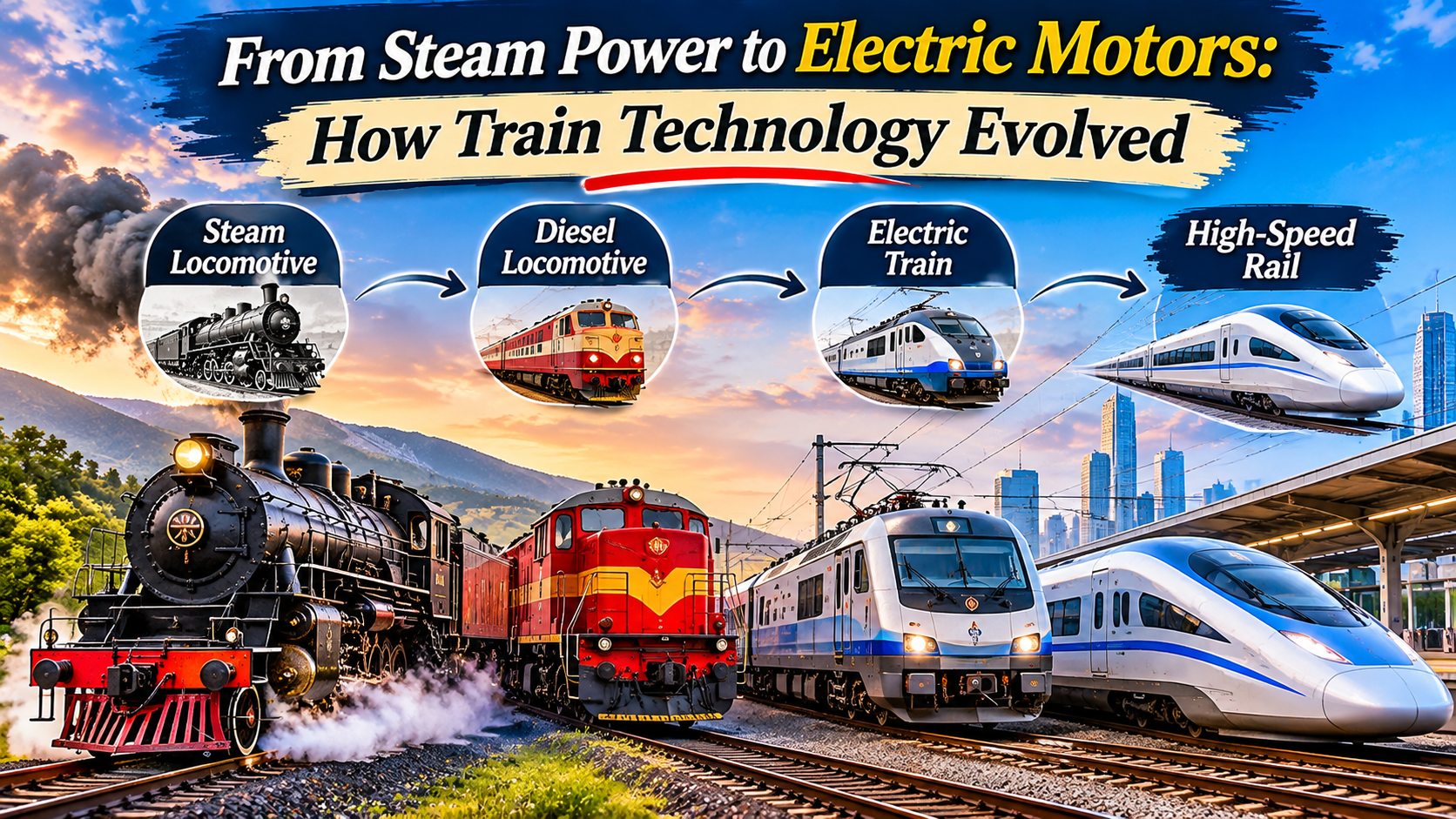
Over time, engineers developed new forms of railway propulsion. Diesel engines replaced steam locomotives across many networks, while electric motors introduced cleaner operation at the point of use, powerful acceleration, and new possibilities for urban and high-speed transportation.
The evolution of train technology was not simply a change from one engine to another. It involved advances in electrical engineering, mechanical design, infrastructure, braking systems, and the management of energy.
Understanding this history reveals how railways became one of the world’s most important transportation systems.
The Early Railway Era: Before Steam Locomotives
Railways existed in basic forms before steam engines became practical.
Early wagonways used wooden or metal tracks to guide vehicles carrying heavy materials, particularly in mining and industrial environments.
Horses or other external forces pulled wagons along these routes.
Guided wheels reduced some of the difficulties associated with moving heavy loads over uneven ground.
However, animal-powered transportation had obvious limitations in speed, endurance, and hauling capacity.
Industrialization increased demand for more powerful transportation systems capable of carrying coal, raw materials, manufactured products, and passengers.
Steam technology offered a promising solution.
How Steam Locomotives Changed Transportation
Steam locomotives became practical during the early nineteenth century as engineers improved boilers, cylinders, and mechanical transmission systems.
Richard Trevithick demonstrated an early steam locomotive in 1804.
Later developments by George Stephenson and other engineers helped establish steam railways as commercially important transportation systems.
The opening of the Stockton and Darlington Railway in 1825 and the Liverpool and Manchester Railway in 1830 marked important milestones in British railway history.
Steam locomotives offered substantial hauling power and could operate without relying on animals.
They helped expand industrial production, accelerate trade, and improve regional connections.
Railway networks subsequently spread across Europe, North America, and other parts of the world.
How a Steam Locomotive Actually Works
A conventional steam locomotive converts heat energy into mechanical motion.
Fuel is burned in a firebox, transferring heat to water inside a boiler.
The heated water produces steam under pressure.
Steam enters cylinders and pushes pistons, creating reciprocating mechanical movement.
Connecting rods transfer this movement to the locomotive’s driving wheels.
The process allows the locomotive to pull passenger carriages or freight wagons.
ENGINEERING DIAGRAM / STEAM PROPULSION
Coal, wood, or oil burns to produce heat.
Heat converts boiler water into pressurized steam.
Steam pressure pushes pistons inside cylinders.
Mechanical rods transmit power to the driving wheels.
Steam locomotives were powerful machines, but they required substantial maintenance.
Operators needed to manage fuel, water, boiler pressure, lubrication, and mechanical components.
Steam engines also lost considerable energy as waste heat.
These disadvantages encouraged engineers to investigate alternative propulsion systems.
Why Railways Began Moving Away from Steam
Steam locomotives remained important for more than a century, but several operational disadvantages became increasingly apparent.
They required frequent servicing, including cleaning, inspection, and maintenance of boilers and moving components.
Preparing a steam locomotive for service could take significant time.
Fuel and water supplies also had to be maintained along railway routes.
Large maintenance facilities were necessary to support extensive steam fleets.
Diesel and electric propulsion offered opportunities to reduce some of these requirements.
However, the transition occurred at different speeds across countries and railway systems.
Economic conditions, fuel availability, infrastructure investment, and operational needs all influenced decisions.
The Rise of Diesel Locomotives
Internal combustion engines became increasingly important in railway transportation during the twentieth century.
Diesel engines offered an alternative to steam boilers by burning fuel inside engine cylinders.
The resulting mechanical energy could be used to power a locomotive.
Diesel locomotives generally required less routine preparation than steam engines and did not need large onboard water supplies for steam generation.
They also provided operational advantages for many freight and passenger services.
In North America, dieselization accelerated during the middle decades of the twentieth century.
Railways gradually replaced many steam locomotives with diesel-powered equipment.
However, diesel locomotives came in different configurations, and their propulsion systems were not always purely mechanical.
Diesel-Electric Locomotives: An Important Engineering Breakthrough
One of the most successful railway propulsion systems combines a diesel engine with electrical transmission.
In a conventional diesel-electric locomotive, the diesel engine drives an electrical generator or alternator.
The electrical system then supplies power to traction motors connected to the locomotive’s wheels.
This arrangement allows the diesel engine to generate power while electric motors provide the force needed to move the train.
Modern control systems regulate how electrical power reaches the traction motors.
Diesel-electric technology became particularly important for heavy freight operations because it offers flexible control of traction.
TECHNOLOGY INSIGHT / DIESEL-ELECTRIC DRIVE
The Diesel Engine Produces Power. Electric Motors Turn the Wheels.
A diesel-electric locomotive normally generates its own electricity onboard. Unlike a fully electric locomotive, it does not require continuous electrical power from overhead wires or a third rail.
The Beginning of Electric Railways
Electric railway technology began developing during the nineteenth century.
Early experimental electric rail vehicles demonstrated that motors could provide practical traction.
Werner von Siemens presented an electric railway demonstration in Berlin in 1879.
Electric street railways subsequently expanded in several cities.
Urban transportation offered particularly suitable conditions for electrification.
Electric motors could provide useful acceleration and operate without producing exhaust fumes directly from the vehicle.
These characteristics were valuable for streetcars, underground railways, and other services involving frequent stops.
As electrical generation and distribution systems improved, electric traction became practical for larger railway networks.
How Electric Trains Receive Power
Unlike conventional diesel-electric locomotives, most fully electric trains receive electricity from infrastructure along the railway.
One common method uses overhead electrical wires.
A device called a pantograph maintains contact with the overhead system and transfers electrical power to the train.
Some urban railway systems instead use an electrified third rail.
The electricity passes through onboard equipment that controls voltage, current, and motor operation.
Traction motors then convert electrical energy into mechanical rotation.
Modern electric trains frequently use sophisticated power electronics and alternating-current traction motors.
These technologies provide precise control over acceleration and braking.
Electric trains can be highly efficient at the vehicle level, although the environmental impact of their electricity depends partly on how that power is generated.
Steam, Diesel-Electric, and Electric Trains Compared
| Feature | Steam | Diesel-Electric | Electric |
|---|---|---|---|
| Primary energy source | Burned fuel | Diesel fuel | External electricity |
| Wheel propulsion | Steam pistons and rods | Electric traction motors | Electric traction motors |
| Local exhaust | Produced | Produced | No onboard combustion exhaust |
| Infrastructure needs | Fuel and water facilities | Fueling and maintenance facilities | Electrical supply infrastructure |
| Typical modern role | Heritage and tourist railways | Freight and non-electrified routes | Urban, intercity, freight, and high-speed services |
Why Electric Motors Improved Train Performance
Electric traction motors provide several important operational advantages.
They can deliver strong torque at low speeds, helping trains accelerate and move heavy loads.
Modern electronic controls allow power to be distributed and adjusted precisely.
Electric traction systems can also support regenerative braking.
During regenerative braking, traction motors operate as generators, converting some of the train’s kinetic energy into electrical energy.
Depending on the railway system, this electricity may be returned to the power network, used by nearby trains, or stored in batteries.
Regenerative braking can reduce energy consumption and mechanical brake wear.
However, the amount of recovered energy varies with train operation, infrastructure, and system design.
The Development of High-Speed Electric Rail
Electric propulsion became especially important as railways pursued higher speeds.
Japan’s Tōkaidō Shinkansen, which began service in 1964, demonstrated the potential of dedicated high-speed electric railways.
Later developments in Europe and Asia expanded high-speed passenger transportation.
High-speed trains depend on more than powerful electric motors.
They require carefully engineered tracks, aerodynamic vehicle shapes, advanced signaling, effective braking systems, and reliable electrical infrastructure.
At higher speeds, aerodynamic resistance becomes an increasingly important engineering challenge.
Modern train designs therefore emphasize streamlined shapes and stable running characteristics.
Electric propulsion works alongside these innovations to support rapid and reliable transportation.
Why Some Railways Still Use Diesel Locomotives
Despite the advantages of electrification, diesel locomotives remain important in many countries.
Installing overhead wires, substations, and other electrical infrastructure requires substantial investment.
For heavily used routes, these costs may be justified by long-term operational benefits.
However, lightly used or geographically remote routes may not generate enough traffic to support the same investment.
Diesel-electric locomotives can operate without continuous external electrical infrastructure.
This flexibility makes them useful for certain freight services and regional railways.
Railway planners therefore consider traffic volume, geography, energy costs, maintenance requirements, and environmental objectives when selecting propulsion systems.
Battery-Electric and Hydrogen Trains
Railway technology continues to evolve beyond conventional diesel and overhead-wire electric systems.
Battery-electric trains can store energy onboard and operate on certain routes without continuous access to overhead wires.
Some designs recharge while traveling on electrified sections or while stopped at suitable facilities.
Hydrogen fuel-cell trains generate electricity onboard through an electrochemical process.
These systems can provide alternatives for selected non-electrified routes.
However, their suitability depends on factors including infrastructure, operating range, energy efficiency, costs, and fuel production methods.
Battery-electric technology may be particularly attractive for some shorter routes with opportunities for charging.
Hydrogen systems may be considered where other approaches face practical limitations, although their overall efficiency and environmental benefits depend heavily on the hydrogen supply chain.
Neither technology automatically replaces conventional electrification in every situation.
How Train Technology Changed Society
The evolution of railway propulsion influenced far more than locomotive engineering.
Steam railways supported industrial growth by connecting factories, mines, ports, and population centers.
Dieselization helped many railway operators improve flexibility and reduce certain maintenance requirements.
Electrification supported the expansion of rapid urban transportation and modern intercity networks.
Reliable rail services also changed how people traveled to work, accessed distant markets, and moved between cities.
Railways became important components of national infrastructure and international trade.
Today, the continuing development of efficient propulsion systems is closely connected to transportation planning, energy policy, and environmental goals.
Frequently Asked Questions
When were steam locomotives first developed?
Practical steam locomotive development began in the early nineteenth century, with Richard Trevithick demonstrating an early locomotive in 1804.
Why did diesel locomotives replace steam engines?
Diesel locomotives offered operational advantages, including reduced preparation requirements, less routine servicing, and improved flexibility on many railway networks.
Are diesel-electric trains actually powered by electric motors?
Yes. In diesel-electric locomotives, a diesel engine generates electrical power that drives traction motors connected to the wheels.
How do electric trains get electricity?
Most conventional electric trains receive power from overhead wires or an electrified third rail.
Are electric trains more energy-efficient than steam trains?
Modern electric traction systems are generally much more efficient at converting supplied energy into useful wheel power than traditional steam locomotives.
Do all high-speed trains use electric motors?
Most major modern high-speed rail systems use electric traction, although railway technologies and service categories vary.
Will battery trains replace diesel locomotives?
Battery-electric trains may replace diesel equipment on suitable routes, but range, charging infrastructure, operating requirements, and cost influence their practicality.
Final Thoughts
The history of railway propulsion reflects nearly two centuries of engineering progress.
Steam locomotives transformed transportation by converting heat into mechanical power, allowing railways to move passengers and freight on an unprecedented scale.
Diesel-electric technology later combined internal combustion engines with electric traction motors, offering new operational advantages.
Fully electric trains introduced efficient propulsion, strong acceleration, and opportunities for regenerative braking.
Modern railway systems continue to develop through advances in electronics, infrastructure, batteries, and alternative energy technologies.
Although different propulsion systems remain useful for different purposes, the overall direction of railway engineering has emphasized improved efficiency, reliability, and performance.
From the smoke-filled steam age to sophisticated electric trains, railway technology continues to shape how people and goods move around the world.