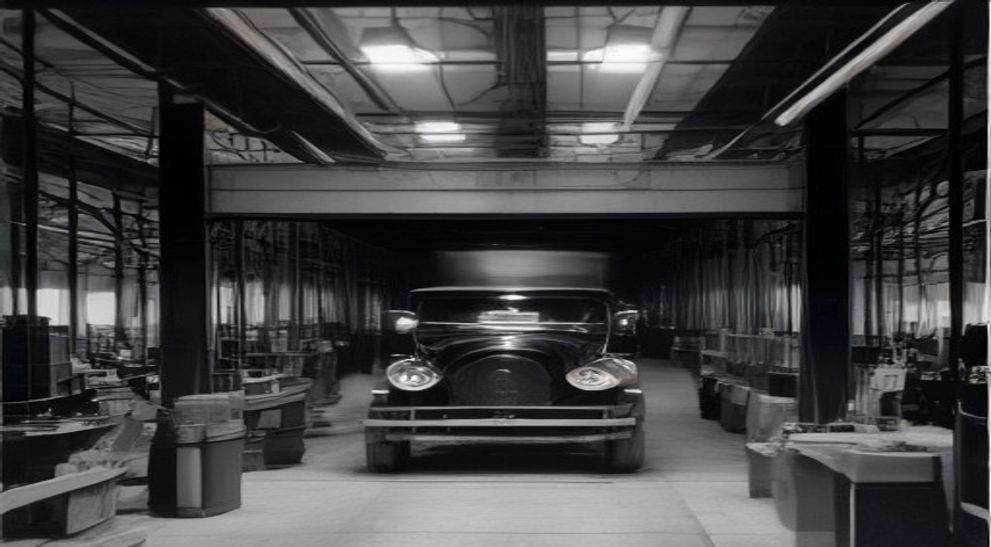
Historical Context: The Artisan Workshop vs. Precision Uniformity
The Traditional Craft Artisan Paradigm
Throughout human history prior to the late nineteenth century, manufacturing was rooted in the craft artisan guild tradition. A master craftsman—whether a carriage-maker, gunsmith, clockmaker, or blacksmith—fabricated products individually from raw materials.
Each component part was hand-forged, hand-filed, and individually chiseled to fit a specific companion piece. Consequently, no two finished goods were identical. If a bolt or gear broke on a carriage, an owner could not purchase a standardized replacement part from a catalogue; the entire machine had to be hauled to a local blacksmith or machinist, who spent hours custom-filing a replacement piece to match the unique dimensions of the broken assembly.
This artisan mode of production suffered from three fatal economic bottlenecks:
1. **Exorbitant Labor Costs**: It required highly skilled, expensive master mechanics with decades of apprenticeships.
2. **Glacial Production Velocity**: Assembly was slow and unpredictable, requiring continuous manual filing, scraping, and fitting.
3. **Minuscule Output Volume**: Finished consumer goods remained costly luxury items inaccessible to ordinary working-class citizens.
The American System of Manufactures and Interchangeable Parts
The theoretical precursor to the moving assembly line was the **American System of Manufactures**, forged in government armories at Springfield, Massachusetts, and Harpers Ferry, Virginia, during the early nineteenth century.
Spurred by military contracts for flintlock muskets, inventors Eli Whitney, Simeon North, and John H. Hall pioneered **interchangeable parts**. By developing specialized single-purpose machine tools—such as milling machines, precision metal shapers, and drop-forges—coupled to hardened steel ‘go/no-go’ limit gauges, armory workers produced metal musket parts machined to such tight tolerances that any random trigger, hammer, or barrel could be assembled into any musket without filing.
By the late nineteenth century, interchangeable parts were adopted by manufacturers of sewing machines (Singer), agricultural reapers (Cyrus McCormick), and bicycles (Pope Manufacturing). Yet, while parts were uniform, assembly remained static: a stationary chassis sat on wooden sawhorses while teams of mechanics walked back and forth fetching parts and tools from distant supply bins, creating immense wasted movement.
Henry Ford and the Genesis of Highland Park
Henry Ford’s Democratic Obsession: The Model T
In 1908, Detroit automaker Henry Ford introduced the **Model T** (popularly known as the ‘Tin Lizzie’). Engineered by Ford alongside master mechanics Childe Harold Wills, C.J. Smith, and Joseph Galamb, the Model T was designed for rugged rural utility: high ground clearance to navigate rutted dirt farm tracks, a simple three-point suspension, and an engine block cast from revolutionary, ultra-strong lightweight vanadium steel alloy.
Demand for the Model T was immediate and overwhelming. In 1908, Ford produced 10,666 cars—an impressive figure for the era, but completely inadequate to satisfy the millions of American families clamoring for personal mobility. Ford recognized that building a universal, low-cost people’s car required demolishing traditional factory architecture.
In 1910, Ford opened the colossal **Highland Park Plant** in Michigan. Designed by industrial architect Albert Kahn, Highland Park was a four-story marvel of reinforced concrete and glass (‘The Crystal Palace’), flooded with natural sunlight and powered by monumental steam-electric generators.
The Disassembly Line Inspiration
The spark of operational genius that birthed the moving assembly line did not originate in automotive engineering, but in the meatpacking slaughterhouses of Chicago and Cincinnati.
In 1912, Ford production engineer William C. ‘Pa’ Klann visited the Swift & Company meatpacking plant in Chicago. Klann observed a continuous overhead conveyor system—the **’disassembly line’**. A cattle carcass was hooked to a moving overhead trolley cable; as it glided past a stationary line of butchers, each worker stood in one spot and performed a single, identical task: one butcher removed the hide, the next cleaved the shoulders, the next excised the ribs.
Klann returned to Highland Park and approached production superintendent Peter E. Martin and factory manager Charles E. Sorensen: ‘If they can slaughter cows on a moving line, why can’t we assemble automobiles on one?’
The Magneto Experiment of April 1913
In April 1913, Ford engineers staged their first controlled operational experiment: assembling the flywheel magneto.
Under traditional methods, a single skilled mechanic sat at a workbench and assembled an entire magneto, producing one unit every twenty minutes (three per hour).
Ford engineers split the assembly into twenty-nine discrete operations. They installed a waist-high wooden waist bench with a moving metal chain that carried magneto flywheels past twenty-nine stationary workers.
The results were staggering: flywheel magneto assembly time plummeted from **twenty minutes down to five minutes**! Subsequent speed adjustments dropped it to thirteen minutes and ten seconds. The moving assembly line was born.
The Mechanical Symphony: Overhead Monorails and Gravity Slides
The Highland Park Chassis Line of October 1913
Encouraged by the magneto triumph, Charles Sorensen and Peter Martin tackled the main vehicle chassis. On an open factory floor on a sunny Sunday morning, Sorensen hitched an empty Model T steel chassis to a heavy windlass rope powered by a stationary winch. As the chassis was slowly pulled 250 feet across the floor, six workers walked alongside, picking up parts from bins placed along the path and bolting them on. Chassis assembly time dropped from 12 hours and 28 minutes to 5 hours and 50 minutes.
By January 1914, Ford had replaced the rope with a mechanized, motor-driven endless floor conveyor chain with steel dogs that engaged car axles, pulling chassis along at an unvarying speed of six feet per minute.
The factory became an integrated hydrodynamic machine:
– Overhead monorail conveyors carried engines, transmissions, and axles down from upper floors directly to the main line.
– Gravity-fed chute slides dropped bolts, nuts, and spark plugs into bins right at each worker’s elbows.
– Overhead gantry cranes lowered finished painted wooden bodies onto the moving chassis at the exact second the frame arrived at the mounting station.
In 1914, chassis assembly time reached an unbelievable **ninety-three minutes**. A brand new Model T rolled off the end of the Highland Park line every forty seconds, fueled, started by electric rollers, and driven out the door under its own power.
Fordism: The $5 Day and Mass Consumption
The Crisis of Monotony and Labor Turnover
While the moving assembly line was a mechanical triumph, it triggered a catastrophic human labor crisis. The moving line stripped workers of all craft autonomy, creativity, and rhythm. A laborer no longer controlled his pace; the unyielding conveyor line dictated his every movement. Men stood in one spot for nine hours a day, performing a single, numbing, repetitive motion: turning nut number 42 on screw number 88 thousands of times a day.
Workers rebelled with their feet. In 1913, Ford’s factory experienced a staggering **370% labor turnover rate**. To maintain a steady workforce of 14,000 employees, Ford had to hire over 52,000 workers annually. Absenteeism surged to over 10% daily, threatening to paralyze the moving line.
The $5 Day Watershed of January 1914
On January 5, 1914, Henry Ford and his executives stunned the global industrial world by announcing the **Five-Dollar Day**.
Ford doubled the prevailing industrial wage from $2.34 to $5.00 for an eight-hour day (down from nine hours). The announcement triggered riots as over 10,000 men besieged the Highland Park gates in sub-zero winter temperatures, desperate for employment.
The Five-Dollar Day was not philanthropy; it was visionary capitalist engineering, codified as **’Fordism’**:
1. It stabilized the workforce, reducing turnover to under 16% and driving worker productivity to unprecedented heights.
2. It created mass consumer demand. Ford understood that if workers were paid subsistence wages, who would purchase the millions of cars rolling off assembly lines? By paying high wages, Ford transformed his own factory workers into the primary consumer market for Model T automobiles.
Comparative Production Paradigm Metrics
Manufacturing Paradigms: From Craft to Lean Production
| Manufacturing Paradigm | Pioneering Era | Workforce Skill Level | Machine Tool Flexibility | Product Variety | Unit Cost / Throughput |
|---|---|---|---|---|---|
| Craft Artisan Production | Pre-1850s | Master artisans / Guild apprentices | General-purpose hand tools | High customization; no two items identical | Very high unit cost; minimal throughput |
| American Armory System | 1800–1890 | Specialized machinists | Dedicated single-purpose machine tools | Standardized models (Muskets, Bicycles) | Moderate cost; interchangeable parts |
| Fordist Mass Assembly | 1913–1970s | Unskilled / Semi-skilled laborers | Rigid specialized conveyor lines | Zero customization (‘Any color so long as it is black’) | Extremely low unit cost; colossal throughput |
| Sloanist Flexible Mass Production | 1920s–1980s (General Motors) | Organized union labor (UAW) | Annual model change tooling | High styling variety (‘A car for every purse and purpose’) | Low cost with planned styling obsolescence |
| Toyota Lean Production (TPS) | 1970s–Present (Taiichi Ohno) | Multi-skilled autonomous teams | Flexible automation (SMED die change) | High variety on single line; Just-In-Time (JIT) | Ultra-low waste; zero inventory; extreme quality |
The Fall of the Model T and Alfred Sloan’s Flexibility
By the mid-1920s, Ford’s rigid mass production became a victim of its own success. The Highland Park line was so specialized that changing a single stamping press required shutting down the entire factory for months. When consumer tastes shifted toward styling, luxury, and variety, Ford’s famous declaration—’Any customer can have a car painted any color he wants so long as it is black’—became a corporate liability.
Alfred P. Sloan of General Motors introduced **Flexible Mass Production**: offering ‘a car for every purse and purpose’ across a stepped hierarchy of brands (Chevrolet, Pontiac, Oldsmobile, Buick, Cadillac), introducing the annual model change, credit financing (GMAC), and vibrant lacquers. In 1927, Ford was forced to halt Model T production after fifteen million cars and spend hundreds of millions of dollars completely retooling for the Model A.
Societal, Economic, and Spatial Consequences
The Price Collapse and Mass Mobility
The moving assembly line achieved the most dramatic price deflation in industrial history. In 1908, the Model T debuted at a price of $850; by 1916, moving line efficiencies slashed the price to $360, and by 1924, a brand-new runabout cost barely **$260**.
Over 15 million Model Ts were manufactured, liberating rural America from crushing agricultural isolation. Farmers could drive to market in minutes, rural mail delivery flourished, and consolidated school districts replaced one-room schoolhouses.
The Global Factory Paradigm
The moving assembly line became the universal template for twentieth-century industrial civilization. Everything from radios, refrigerators, and vacuum cleaners to aircraft and electronic computers was reorganized around moving conveyor lines.
During World War II, Ford’s Willow Run bomber plant adapted the moving assembly line to aviation, rolling out a colossal four-engine Consolidated B-24 Liberator heavy bomber every 63 minutes, forming the ‘Arsenal of Democracy’ that overwhelmed the Axis powers. The moving assembly line created the blue-collar middle class, dictated modern factory architecture, and cemented mass consumer society.
Ergonomics and the Science of Motion Study: The Gilbreths
To optimize moving assembly lines without breaking human workers, early twentieth-century industrial engineers Frank and Lillian Gilbreth pioneered the science of **Time and Motion Study**.
The Gilbreths analyzed human physical movement using high-speed motion picture cameras and micro-chronometers, breaking manual assembly down into eighteen fundamental, indivisible elemental motions which they anagrammatically termed **’Therbligs’** (such as Search, Find, Select, Grasp, Transport Loaded, Position, and Assemble).
By redesigning conveyor heights, tool balancer suspensions, and parts hopper angles to eliminate awkward reaching and twisting, motion study transformed assembly line ergonomics. These scientific management principles reduced physical strain, lowered occupational repetitive-motion injuries, and synchronized human biomechanics with the tireless velocity of motorized conveyor chains.
Frequently Asked Questions (FAQ)
Why was the Model T famously only available in black?
Between 1914 and 1926, Model Ts were painted exclusively black for pure assembly line speed. Early oil-based colored paints took days or weeks to dry, clogging up valuable factory storage space. Ford discovered that Japanese black asphaltum varnish (baked in high-temperature ovens) dried in minutes, matching the blistering pace of the moving conveyor line.
Did Henry Ford invent the assembly line?
Henry Ford did not invent the concept of division of labor or interchangeable parts. However, Ford and his production engineers (Charles Sorensen, Peter Martin, and C.W. Wills) were the first in human history to combine interchangeable parts, stationary division of labor, gravity-fed slides, and motorized moving conveyors into an integrated, continuous mass-production automotive system.
What was the significance of Henry Ford’s Five-Dollar Day in 1914?
In 1914, Ford doubled worker wages to $5 per day and cut daily hours from 9 to 8. This eliminated crippling 370% employee turnover, boosted worker productivity, and created an affluent blue-collar middle class that could afford to buy the very automobiles they manufactured on the line.
How did moving assembly lines affect product quality initially?
Initially, product quality and uniformity soared because parts had to be machined to flawless interchangeable tolerances to fit without hand filing on a moving line. However, because workers were rushed by the moving conveyor, loose bolts or defects occasionally slipped through, leading later industrial pioneers like Taiichi Ohno at Toyota to invent Lean Production, giving workers the authority to pull an ‘Andon cord’ to stop the line when defects occurred.